ZKsync LATAM — Community Activation Program — Season 2 Report
Period: March – Aug 2026 (Season 2)
Individual accounts and brand names have been obfuscated for commercial privacy reasons.
Executive Summary
Season 1 was about repositioning: moving from a builder community to an institutional narrative. Season 2 completed that transition — ZKsync LATAM now operates as a full business development function for the region.
The team stopped running community programming as a primary activity and rebuilt around a structured commercial pipeline: ICP definition, CRM discipline, staged qualification, and proposal delivery. The result is 34 accounts in active radar across four segments, 29 documented interactions with external institutions, 10 accounts at proposal stage or beyond, and 4 institutions that have formally accepted to receive commercial proposals.
We also designed and submitted for signature our first distribution partnership agreement — a regional financial infrastructure organization that reaches financial institutions across multiple LATAM markets — validating a model where ZKsync provides the infrastructure and partners carry distribution into their existing client base.
Brazil was confirmed as the anchor market. Coverage now covers six countries in LATAM.
Season 2 Scope and Commitments
Our scope for Season 2 was defined around five commitments:
-
Build and strengthen the institutional funnel in Brazil as the anchor market
-
Develop and activate a regional distribution partner funnel — semi-public entities, development banks, fintech chambers, financial infrastructure bodies
-
Accelerate the fintech pipeline across LATAM
-
Improve funnel quality, velocity, and infrastructure — CRM discipline, stage progression, localized materials
-
Structured ICP sourcing and top-of-funnel development — events, roundtables, regulatory introductions
Each commitment carried specific numeric targets. Status against those targets is below.
Status Against Commitments
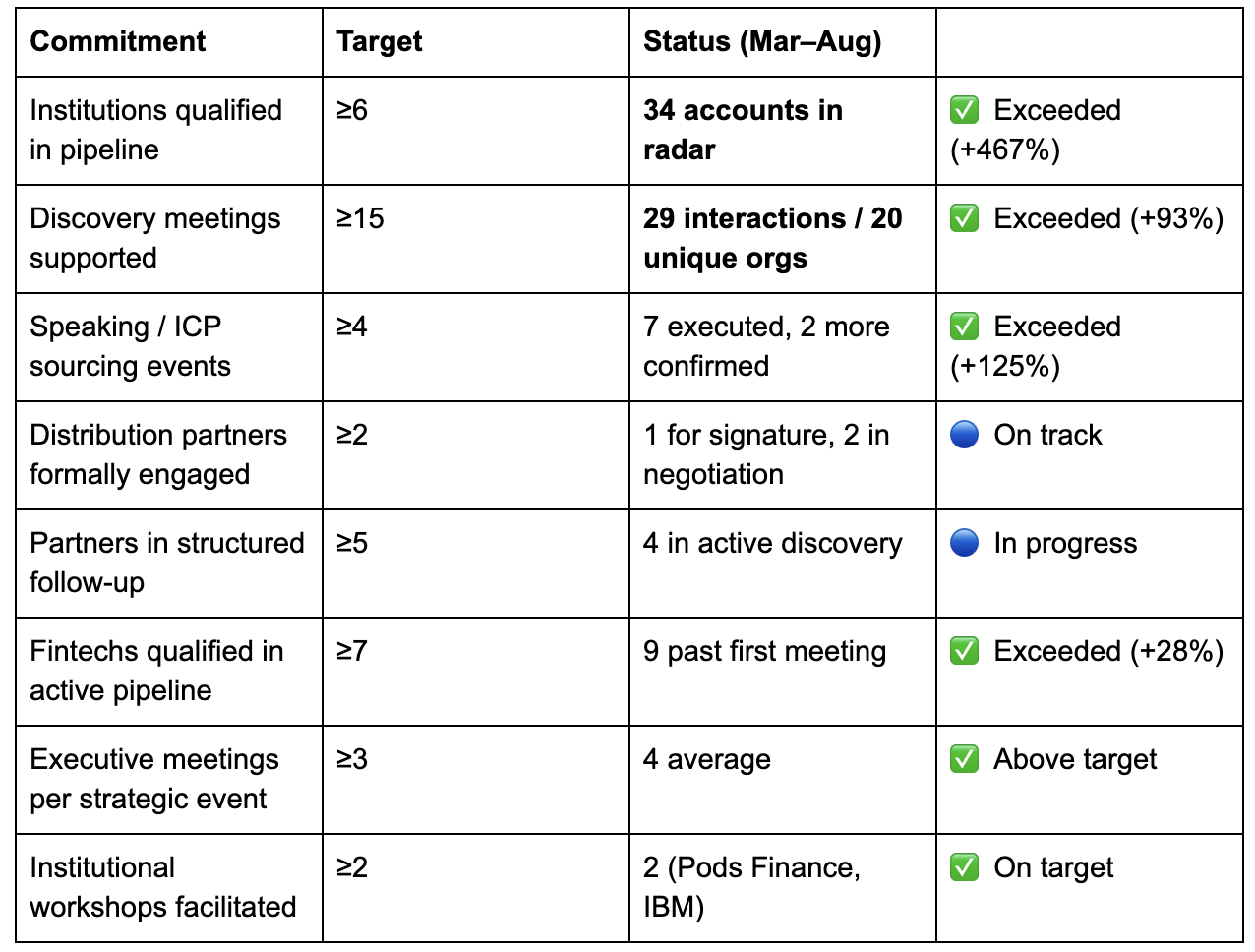
Where we are ahead: top-of-funnel generation and meeting volume significantly exceeded plan. The pipeline is deeper and broader than committed.
Where we are behind: formally signed agreements have been moving through multiple executive and legal review steps — not stalled, but slower to close than planned.
Pipeline Composition
Accounts are counted cumulatively at each stage reached during the period.
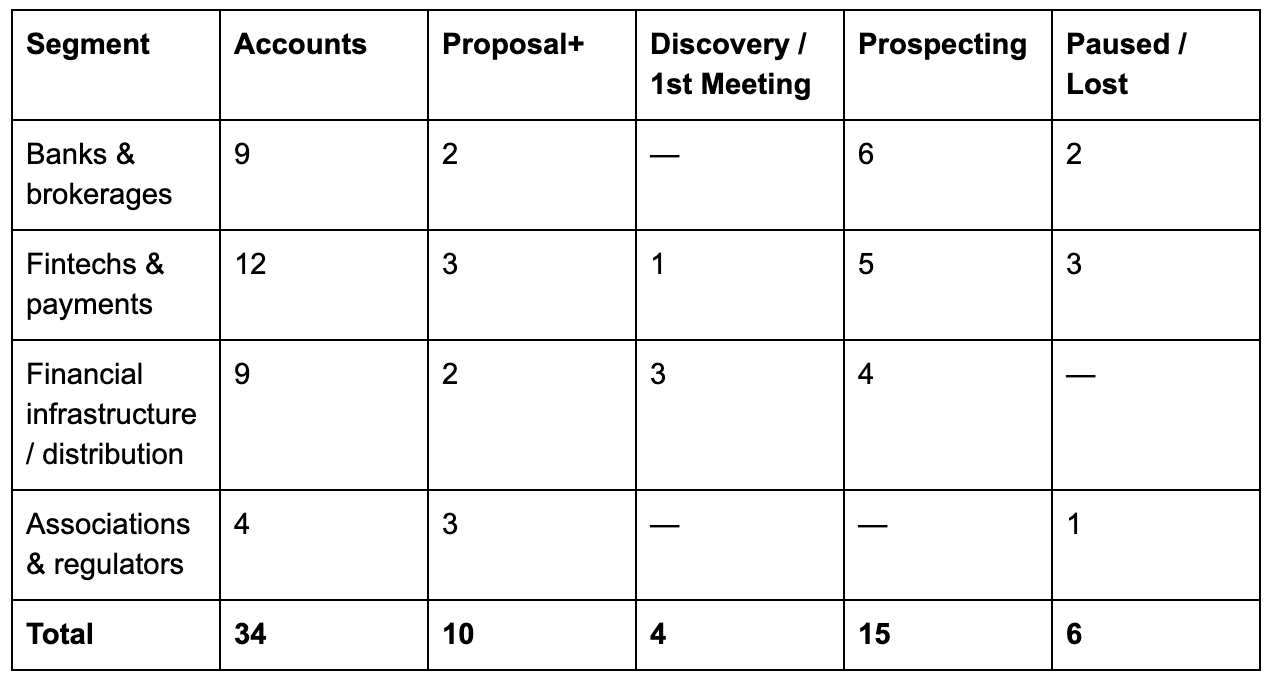
Geographic coverage: Brazil (anchor), Argentina, Mexico, Colombia, Peru, United States.
Institution types engaged: national stock exchange, tier-1 and mid-size commercial banks, digital banks, crypto exchanges, OTC desks, payment processors, card networks, asset tokenization platforms, DeFi infrastructure providers, development finance organizations, financial sector trade associations, and a UN agency exploring financial inclusion use cases.
Key Activities Completed
1. Transition to a structured BD operation
The most significant change this season was operational, not promotional. We built:
-
A defined ICP — regulated financial institutions with data privacy constraints, not crypto-native builders
-
Staged pipeline discipline — prospecting → discovery → alignment → NDA/use case → proposal, with CRM tagging by segment, country, trigger signal, and stage
-
A proposal motion — moving from “interest expressed” to formally submitted commercial proposals, including a managed 30-day POC offer developed with Matter Labs and a formal proposal for a major financial institution currently in evaluation.
This is what allowed 4 institutions to formally accept commercial proposals within the period.
2. First distribution partnership proposed for signature
We closed a partnership agreement proposal with a regional financial infrastructure organization with reach into financial institutions across multiple LATAM markets. Terms include a six-month Prividium testnet instance, joint pipeline development, and a defined deployment trigger for H2 2026. The agreement was submitted for signature to the parties.
A second distribution agreement — with a Brazilian technology provider serving financial institutions — is in legal negotiation.
The agreement template developed for the first partner has been generalised and is now reusable for additional distribution candidates. This is the highest-leverage motion we identified this season: partners already hold the client relationships we would otherwise need to build cold.
3. Regulatory and association engagement
We established active working relationships with three Brazilian financial sector bodies: a tokenization trade association, an organization affiliated with the central bank, and an association representing 80+ financial institutions.
We contributed a written position on Brazil’s proposed stablecoin regulatory framework, which was incorporated into an industry submission to the national legislature.
We also participated in a capital markets tokenization pilot consortium alongside a bank, an asset manager, and a global enterprise technology provider, with Prividium positioned as the confidential pre-processing layer.
Association access has proven to be one of the most efficient credibility signals available in this market — it converts cold institutional outreach into warm, pre-qualified conversations.
4. Events and top-of-funnel sourcing
-
A major crypto industry conference (US, May) + a key institutional/web3 event (Brazil, March) — 29 recorded interactions with institutions across six countries; the highest-yield sourcing activities of the period.
-
A government-backed blockchain event (Brazil, May) — speaker slot representing ZKsync LATAM to an institutional and public sector audience
-
Brazil’s leading tokenization conference (June) — speaker slot; audience of financial institutions, fintechs, and regulators directly overlapping our active pipeline.
-
Major Blockchain industry events (July, August) - Confirmed speaker invitation to participate in key events where all the regulators and finance industry gathers.
-
Invitations for the rest of 2026 - We have been formally invited to participate in key fintech and banking events in Brazil, Mexico and Argentina for the rest of 2026.
5. Materials and localization
Institutional decks were adapted for Portuguese and Spanish audiences, with narrative reframed around regulatory compliance and data sovereignty rather than technical zero-knowledge concepts.
Impact Assessment
We moved from generating interest to generating pipeline. Season 1 delivered introductions and a pilot. Season 2 delivered a structured, staged, measurable funnel with proposals in the hands of institutional decision-makers.
We validated the distribution model. One proposed partnership agreement was submitted, and another in negotiation; a reusable template was developed, and three additional candidates in discovery. This is now a repeatable motion rather than a one-off.
We contributed to product-market fit. Field feedback from institutional conversations — legal framework constraints, deployment expectations, compliance requirements, competitive positioning — has been fed back to Matter Labs and has informed how Prividium is presented to regulated institutions.
We established regulatory standing in the anchor market. Contributing to a national legislative submission and participating in a capital markets tokenization pilot gives ZKsync a position that pure commercial outreach cannot buy.
ZKsync LATAM — Community Activation Program Season 2 Report (March – Aug 2026)