The Staking Pilot Program Admins and Tally present the ZKnomics Staking Pilot Season 1. The Season 1 reflection also includes an announcement for Season 2 below.
Overview
The ZKnoimcs Token Staking Pilot Program was deployed as a time-limited pilot that allows ZK token holders to stake their tokens and receive rewards while strengthening active governance participation. When participants stake, they delegate their voting power to active governance participants (Delegates) and receive ZK rewards in return.
The purpose of the Staking Pilot Program is twofold:
-
test and assess Tally staking infrastructure & staking parameters in preparation for the decentralized sequencer
-
increase delegated ZK + active voting power via the built-in delegate-to-stake mechanism
The pilot program was designed to run for two 3-month seasons. Season 1 was launched on February 9th, and ran until May 11th. This report summarizes key metrics and takeaways from Season 1 of the Staking Pilot Program and offers a suggestion for how to move forward.
Season 1 Key Stats
Key Staking Metrics:

Season 1 Goal from Proposal: 400M ZK staked in total, with a maximum of 10M ZK distributed over 3 months (2.5% for 3-months or 10% annualized), 0 incidents.
-
Max Amount ZK staked: 355M ZK (87% of 400M cap)
-
Max Total TVL: ~$7M
-
Total # of addresses staked: 4,397
-
Total ZK reward distributed: 5.3M ZK out of 10M ZK available for Season 1
-
Average Time Staked (at time of report publish): 65
-
Number of incidents: 0
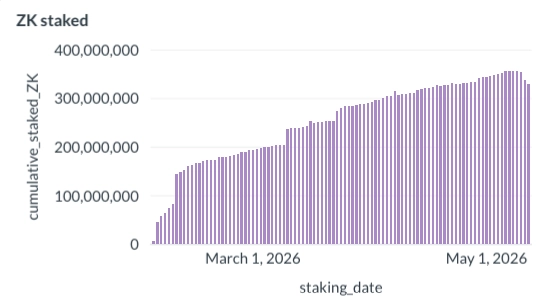
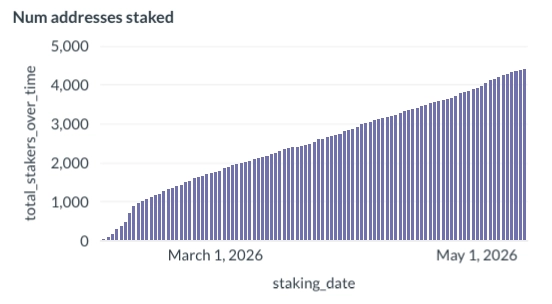
All unminted ZK from the Season 1 capped minter will remain unminted. All minter roles have been revoked from the Season 1 capped minter by the Program Admin.
Active Delegation Metrics:
Season 1 Goal from Proposal: Net increase of +200M active voting power (50% of staked ZK)
-
Total active delegation impact:
-
Net new delegation from announcement of Season 1 (Feb 2) to end of Season 1 (May11): 205M ZK
-
Announcement of Season 1 start (Feb 2): 958M
-
Start of Season 1 (Feb 9): 1,024B
-
Peak active delegation (May 29th): 1.187B
-
End of Season 1 (May 11): 1.163B
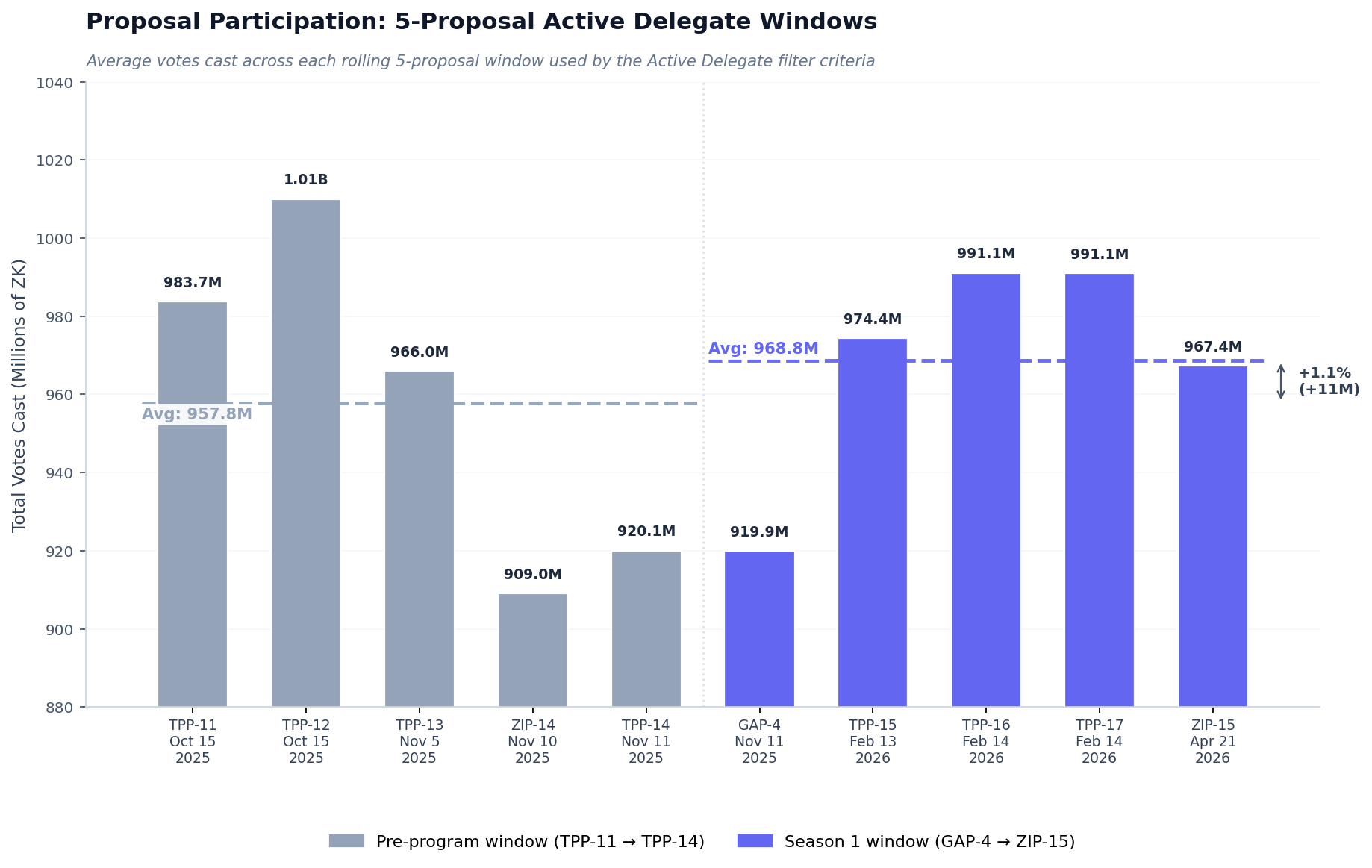
 Review total active delegation query from the ZKsync Governance Performance Dashboard. The sudden decrease in total active delegation that took place on April 30th was due to some active Delegates becoming inactive by not voting on ZIP-15.
 -
-
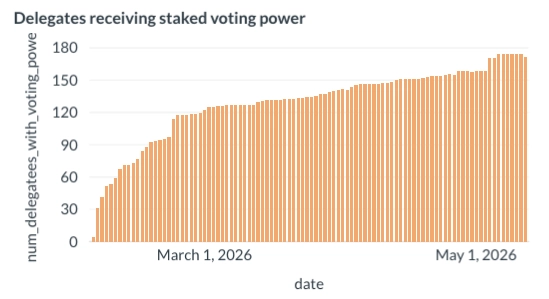
Number of Delegates who received delegations from the Staking Pilot: 173
-
Delegates who received most delegations (top 6):
Delegate Description Delegation Received via Staking Pilot Total Delegation at time of report L2Beat Impartial watchdog for the Ethereum Layer2 ecosystem 78,094,735 148.2M SyncSwap Largest app on ZKsync Era 67,681,392 128.36M Matter Labs Core development team behind ZKsync 63,976,060 134.38M Memento ZKsync chain & integration partner for Prividium 31,386,617 44.61M Grow the Pie Ethereum ecosystem analytics 16,210,600 40.43M ZKsync LATAM Ecosystem partner supporting BD in LATAM 14,255,333 24.3M
Key Staking Infra Tested
-
Tally’s Staking Infra: The Staking Pilot was deployed fully on Tally’s staking infra, all which were considered a success. This includes:
-
Staker contract: The contracts had no security incidents, bugs, or downtime throughout Season 1.
-
ZKStaker Contract: 0x24B5292aDC6CF2373Ddbc09c8699B4F88C6b2CDB
-
-
Staking interface: The ZKnomics Staking Pilot interface had no security incidents, bugs, or downtime throughout Season 1. There was only 1 UX improvement made to the interface to ensure a smoother network confirmation process.
-
Delegate-to-stake mechanism: increased total active voting power by about 22% (from ~957M to ~1.162B)
-
-
Tally tagging system & featured (active) Delegates filter: Launched in January 2026, the Key Participants and Active Delegate tagging system enabled a “Featured” filter for the Staking Pilot interface, allowing ZK holders to quickly identify active delegates. This feature helped ensure staking program rewards are contingent upon delegating to an active delegate. By simplifying the discovery of active representatives, this feature significantly increased active delegated voting power throughout Season 1.
-
Increasing APR levels: The staking program started at 3% and gradually increased to 10%, but there was a lot of operational work to change the APR. The APR often fell slightly short (e.g. 9.7% instead of 10%) due to new stake entering the system between the time of the mint request and execution.
-
Delay Mod for ZK reward minting: To test an additional security layer between the program service provider (Tally) and the Program Admin, a Delay Mod was deployed to sit between the Season 1 capped minter and the staker contract, creating a veto window for the Program Admin and any reward mint requests from Tally. The delay window was originally set to 12 hours, but was decreased to 6 hours around halfway through the program to provide more accurate APR targeting.
Key Takeaways & Improvements for Future Seasons
Season 1 of the Staking Pilot Program was successful in fulfilling the purpose of the Staking Pilot program. It successfully tested the Tally staking infrastructure, various staking parameters and management tooling, and the delegate-to-stake mechanism successfully increased the total active voting power, strengthening the ZKsync governance system.
There were also some lessons learned, specifically in regards to APR% management.
-
Tally interface worked and was intuitive: There were a few minor support requests throughout the entire 3 months of Season 1, and one was interface functionality related and it was addresses within 24 hrs.
-
Delegate-to-stake: The delegate-to-stake mechanism was key for strengthening the governance system, reaching active delegation amount that is double quorum (630M ZK). It is highly recommended to include this mechanism in future staking programs.
-
Featured/Active Delegate Filter: This feature on the Staking Pilot interface increased active delegated voting power throughout Season 1. However, to mitigate risks of governance capture caused by heavy delegation concentration on certain Delegates, the filter required manual adjustments throughout Season 1. To ensure long-term decentralization, we propose implementing a hard cap for the “Featured” list. For example, “Delegates exceeding a threshold of X ZK would be automatically excluded from the featured filter to encourage a more balanced distribution of voting power.”
-
Yield Optimization: Targeted APR was a pain point. If future seasons or staking programs use targeted APR, it would recommended to explore onchain automation options. These options were explored before launching Season 1, however we decided not to implement for Season 1 until we understood the need. However, we suggest exploring alternative options as well, including fixed APR, to optimize outcomes for participants.
-
Participation: Staking appetite at various APR%. There was a slow progression of staked ZK over Season 1, but even as the targeted APR% increased, the participation threshold (400M) was never met. There needs to be more research done to understand an optimized APR%. Another known blocker to participation was lack of access for custodied tokens. Enabling staking participation with key custodians will be a key adjustment needed for future staking programs.
-
Delay Mod: Although this was a good feature to test for this specific set up, it may not be necessary or realistic depending on future APR / reward distribution setups.
Season 2 Update: Paused
Although Season 1 has been a success, the Program Admin is deciding to pause moving forward with Season 2.
The decision to pause the program following Season 1 is a strategic decision to prioritize long-term network efficiency over temporary pilot metrics. By pausing now, resources can be reallocate toward designing a more robust, “institution-ready” staking architecture that aligns with the planned deployment of the decentralized sequencer currently scheduled for later this year.
Reasons for this recommendation:
-
Sequencer Alignment: The next season of the Staking Pilot should be more closely aligned with the expected setup and parameters of the envisaged deployment of the decentralized sequencer, which has shifting to late H2 2026.
-
Institutional Access: Current custodian limitations prevent large-scale participation. Given the complexity of enabling staking on the custodian side, it would be most effective to have them enable it once a more permanent contract and staking system is confirmed.
-
Assess APR model & contract: In order to better optimize outcomes for staking participants, the APR model and staker contract should be assess and potentially updated before moving forward with a future season.
The Program Admin will notify the community if Season 2 is unpaused later this year. Noting that the capped minters for the Staking Pilot Program expire on December 31, 2026.
Have feedback about Season 1 of the Staking Pilot?
Please share your feedback and thoughts here on the forum!